
Hybrid Cloud vs Private Cloud: Which Is Right for Your Enterprise?
Choosing the wrong cloud deployment model is one of the most expensive decisions an IT organisation can make. This guide cuts through the confusion with a clear, direct comparison of hybrid cloud and private cloud, what each model actually delivers, where each one falls short, and the specific factors that should drive your decision.
Choosing the wrong cloud deployment model is one of the most expensive decisions an IT organisation can make. This guide cuts through the confusion with a clear, direct comparison of hybrid cloud and private cloud, what each model actually delivers, where each one falls short, and the specific factors that should drive your decision.
Key Industry Statistics
- 54%: of organisations have adopted hybrid cloud models (Cloud Security Report 2025).
- 45%: of organisations use private cloud alongside other models (O'Reilly 2025).
- 30%: cost savings reported by hybrid cloud users vs single-model approaches.
- 17.6%: CAGR of MEA hybrid cloud market 2025 to 2030.
Most enterprise cloud decisions start with the same pressure: the organisation needs to modernise, move faster, and reduce infrastructure overhead, but it also has sensitive data, compliance obligations, and workloads that cannot simply be handed to a public cloud provider and forgotten about. Private cloud and hybrid cloud are the two models that address this tension, but they do so in very different ways and at very different costs. GBG's cloud solutions practice in Cairo and Riyadh helps enterprise teams navigate exactly this decision.
Understanding the difference matters more than ever in 2026. Saudi Arabia's NDMO data localisation framework, Egypt's PDPL Executive Regulations, and the NCA's Cloud Cybersecurity Controls are all actively shaping which cloud model is legally viable for regulated workloads in this region. The wrong choice is not just technically suboptimal; it can be a compliance failure.
Table of Contents
- What Is Hybrid Cloud? What Is Private Cloud?
- Head-to-Head Comparison: 8 Dimensions
- Private Cloud: Where It Excels and Where It Limits You
- Hybrid Cloud: Where It Excels and Where It Gets Complex
- The MEA Lens: Data Sovereignty, NCA, and PDPL
- Use Cases: Which Model Fits Which Scenario?
- How to Decide: A Practical Framework
- Frequently Asked Questions
What Is Hybrid Cloud? What Is Private Cloud?
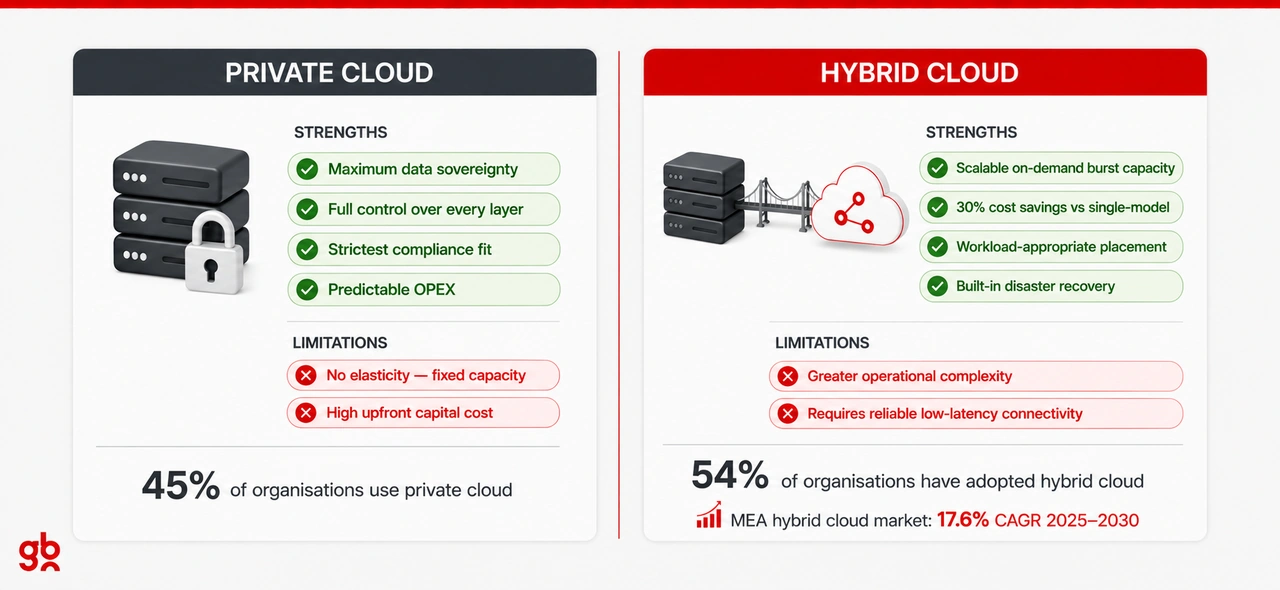
Private Cloud (Dedicated Infrastructure · Single Organisation)
A private cloud is dedicated computing infrastructure, whether hosted on-premises in your own data centre or by a third-party provider in a dedicated environment, used exclusively by a single organisation. No resources are shared with other tenants. The organisation has full control over configuration, data placement, security policy, and performance.
- Primary Strengths: Maximum control and data sovereignty; consistent, predictable performance; meets strictest compliance requirements; no dependency on internet connectivity.
- Primary Limitations: High upfront capital cost; limited elasticity for demand spikes; full operational responsibility on your internal team.
Hybrid Cloud (Private + Public Connected · Flexible Workload Distribution)
A hybrid cloud connects a private cloud environment (on-premises or dedicated) with one or more public cloud platforms through a unified management layer. Workloads can move dynamically between environments: sensitive data stays in the private environment while variable-demand workloads, development, testing, analytics, and burst capacity run in the public cloud.
- Primary Strengths: Balances security with scalability; cost-optimises by workload type; avoids public cloud vendor lock-in; supports gradual cloud adoption.
- Primary Limitations: Requires reliable, low-latency connectivity between environments; greater operational and governance complexity; higher management skill requirement.
Head-to-Head Comparison: 8 Dimensions
| Dimension | Private Cloud | Hybrid Cloud |
|---|---|---|
| Upfront cost | High — dedicated hardware, software licences, and data centre infrastructure. | Moderate — private component plus public cloud subscription. Lower initial capital outlay overall. |
| Ongoing cost | Predictable OPEX for on-premises components. No per-usage public cloud charges. Can be more cost-efficient for steady, high-utilisation workloads. | Variable — public cloud costs scale with usage. Can deliver 30% savings by moving variable workloads to public and keeping steady workloads on reserved private capacity. |
| Scalability | Limited — capacity is constrained by what has been provisioned. Scaling requires hardware procurement. | High — variable demand bursts into public cloud instantly. No hardware procurement delay. |
| Security control | Maximum — full control over configuration, access, network segmentation, and data placement. | Strong but shared — private component is fully controlled; public component relies on provider security with configurable controls. |
| Data sovereignty | Maximum — data never leaves the organisation's infrastructure. Ideal for top-tier classified or legally restricted data. | Configurable — sensitive data can be ring-fenced in the private environment while less sensitive workloads use public cloud within compliant regions. |
| Compliance fit | Best fit for the strictest regulatory requirements where data must remain within organisational control at all times. | Strong fit for most enterprise compliance requirements when the private component hosts regulated data and public cloud hosts non-restricted workloads. |
| Operational complexity | Medium — single environment to manage, but full operational responsibility on the internal team. | Higher — two environments, unified identity, consistent policy enforcement across environments, and reliable connectivity between them. |
| Flexibility for growth | Limited — scaling requires capital investment and hardware lead times. | High — business growth absorbs into public cloud capacity without procurement cycles. |
| Disaster recovery | DR requires a secondary on-premises site or a dedicated off-site arrangement. More complex and expensive to implement at the same resilience level. | Stronger — public cloud provides a natural DR target for private workloads. Replication to a cloud region is built into most hybrid architectures. |
| Vendor dependency | Depends on private cloud platform and hardware vendor. Avoids public hyperscaler dependency entirely. | Partial — public cloud component creates a hyperscaler relationship, but private component and portability layers reduce lock-in risk. |
Private Cloud: Where It Excels and Where It Limits You
Private cloud is the right choice when control is non-negotiable. If your organisation processes data that cannot legally or operationally sit on a shared infrastructure, if your workloads are highly predictable and run at consistent high utilisation, or if your regulatory environment requires documented evidence of data location at all times, private cloud delivers what no public or hybrid model can match: absolute control over every layer of the environment.
The sectors where private cloud consistently makes sense are finance, defence, government, healthcare in jurisdictions with strict data residency rules, and organisations that have already invested heavily in on-premises infrastructure with significant remaining useful life. For these organisations, the economics of private cloud often make sense even against the higher upfront cost, because the alternative involves either accepting compliance risk or paying a significant premium for sovereign cloud services from public hyperscalers.
The limitation that catches most organisations: Private clouds are built to a fixed capacity. When demand spikes above that capacity, there is no instant elasticity. An organisation whose workloads are steady 350 days a year but peaks at 200 per cent of normal capacity during month-end, product launches, or fiscal year-end must either overprovision the private cloud and pay for idle capacity most of the year, or accept performance degradation during peaks. This is the exact problem hybrid cloud was designed to solve.
Hybrid Cloud: Where It Excels and Where It Gets Complex
Hybrid cloud's core value is workload-appropriate placement. Sensitive, regulated, latency-critical, or compliance-constrained workloads run in the private environment. Variable, scalable, development, analytics, and burst workloads run in the public cloud. The result is that each workload runs in the environment best suited to its cost profile, security requirement, and performance demand, rather than forcing all workloads to conform to the constraints of a single environment.
Hybrid cloud users consistently report 30 per cent faster deployments, 35 per cent agility gains, and up to 30 per cent cost savings compared to single-model approaches. For MEA enterprises managing a mix of regulated and non-regulated workloads, this workload-appropriate placement model is increasingly the architecture of choice. The MEA hybrid cloud market is growing at 17.6 per cent CAGR from 2025 to 2030, driven primarily by data sovereignty requirements and the need to scale AI and analytics workloads without the cost of private infrastructure for those use cases.
The complexity price: Hybrid cloud does not reduce operational work. It introduces new categories of it: unified identity management across environments, consistent security policy enforcement in two places, reliable low-latency connectivity between the private and public components, and cost governance that spans two billing models. For organisations that lack the internal cloud engineering maturity to manage this complexity, a managed Azure hybrid cloud service through a qualified partner is the practical route rather than attempting full self-management.
The MEA Lens: Data Sovereignty, NCA, and PDPL
For enterprises operating in Egypt and Saudi Arabia, the cloud model decision is not purely technical. It intersects directly with the regulatory obligations that both countries now actively enforce.
In Saudi Arabia, the NCA's Cloud Cybersecurity Controls (CCC-2:2024) explicitly require that core services, including primary data storage, backups, and disaster recovery for regulated organisations, must remain within Saudi infrastructure. The NDMO Data Localisation Framework updated in 2024 requires that government data and sensitive private sector data classified at Restricted or above must be stored, processed, and transmitted within the Kingdom. Public hyperscaler regions operated from outside Saudi Arabia do not satisfy this requirement through contractual SLAs alone. This means organisations with Restricted-classification data must implement either a private cloud in-Kingdom or a sovereign hybrid architecture that keeps that data on Saudi-operated infrastructure.
In Egypt, the PDPL Executive Regulations (effective November 2025, enforced from October 2026) introduce a licensing regime for cross-border data transfers and require that organisations processing sensitive personal data demonstrate control over where that data is stored. The Egypt PDPL Personal Data Protection Centre will assess these controls as part of its licensing process.
Practical implication for MEA enterprises: For most organisations in Egypt and Saudi Arabia, the hybrid cloud model is the pragmatic compliance-compatible solution. Sensitive and regulated data is placed in a private or sovereign cloud component operating within national borders. Less sensitive workloads, development environments, analytics platforms, and scalability burst capacity sit on public cloud resources in compliant regional availability zones. This architecture satisfies NCA CCC requirements, NDMO data localisation obligations, and PDPL transfer controls simultaneously, while preserving the scalability and cost efficiency that pure private cloud cannot deliver.
Use Cases: Which Model Fits Which Scenario?
Private Cloud Scenarios
Choose private cloud when:
- Data is classified at the highest national security or confidentiality tier.
- Regulation explicitly prohibits data from residing on third-party infrastructure.
- Workloads are highly consistent and run at 80 per cent or above utilisation year-round.
- Latency requirements are sub-millisecond and consistent, requiring proximity to on-premises systems.
- The organisation is in defence, central government, or financial services with strict data residency mandates.
- Existing on-premises hardware investment has significant remaining life.
Hybrid Cloud Scenarios
Choose hybrid cloud when:
- The workload portfolio includes both regulated and non-regulated data that can be separated.
- Demand is predictable at baseline but includes significant seasonal or event-driven peaks.
- Development, testing, and analytics workloads are growing faster than the core business.
- The organisation needs cloud-native AI and machine learning capabilities without migrating core systems.
- Disaster recovery to a geographically separate environment is a business continuity requirement.
- The organisation wants to adopt cloud progressively without a full infrastructure replacement.
How to Decide: A Practical Framework
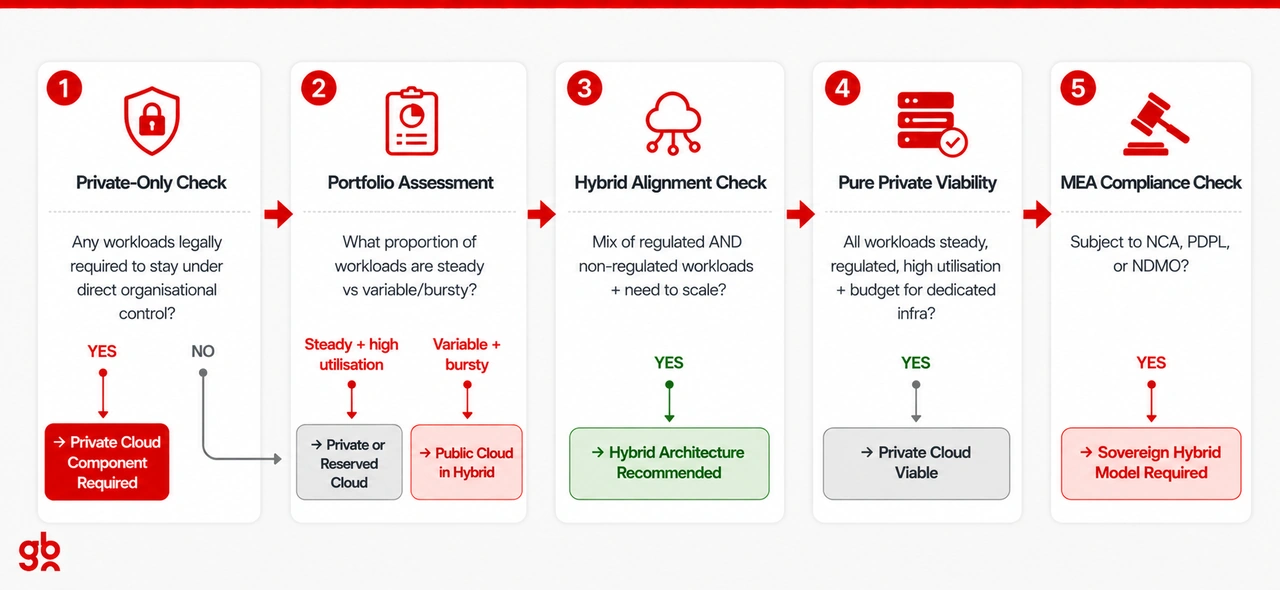
Work through the decision sequence in the order that matters:
- Private Only Check: Do any of your workloads process data that is legally or regulatorily required to remain under direct organisational control at all times, with no third-party involvement? If yes, those workloads go to a private cloud component regardless of any other consideration.
- Portfolio Assessment: After identifying private-only workloads, classify the rest of your portfolio. What proportion are steady and predictable vs variable and bursty? Steady, high-utilisation workloads are candidates for private or reserved cloud. Variable workloads are candidates for public cloud within the hybrid model.
- Hybrid Alignment: If your portfolio contains both regulated and non-regulated workloads and you need to scale variable workloads without capital expenditure, a hybrid model is almost certainly the right architecture. The private component hosts what must stay controlled; the public cloud component handles everything else.
- Pure Private Viability: If virtually all your workloads are steady, regulated, and run at consistently high utilisation, and if your budget supports dedicated infrastructure and you have the internal team to manage it, a well-designed private cloud can deliver better long-term economics than hybrid or public alternatives for your specific portfolio.
- Regional Compliance Check: Are you an MEA enterprise subject to NCA, PDPL, or NDMO regulations? If yes, consult your compliance obligations before finalising architecture. In most cases, a sovereign hybrid model, with the private component operating within your national jurisdiction, is the architecture that satisfies both compliance and operational requirements simultaneously.
For most mid-to-large enterprises in Egypt and Saudi Arabia, the practical answer in 2026 is a hybrid architecture: a private or sovereign cloud component for regulated, sensitive, and latency-critical workloads, with a public cloud component for variable, scalable, and development workloads. Pure private cloud remains the right choice for a specific subset of organisations whose entire workload portfolio is regulated at the highest tier or whose utilisation patterns make dedicated infrastructure more economical.
Frequently Asked Questions
What is the main difference between hybrid cloud and private cloud?
A private cloud is a dedicated computing environment used exclusively by one organisation, either hosted on-premises or by a third-party provider in isolation. It offers maximum control and data sovereignty but limited scalability. A hybrid cloud connects a private cloud environment with one or more public cloud platforms, allowing workloads to be distributed based on sensitivity, cost, and demand. Sensitive data stays in the private component while variable or less sensitive workloads use the public cloud.
Is hybrid cloud more secure than private cloud?
Not inherently. A well-designed private cloud offers the highest possible security for the data it holds because nothing is shared and no data traverses a public network connection. A hybrid cloud introduces a network connection between environments, creating an additional security surface. However, a well-designed hybrid cloud with zero-trust architecture and encrypted connections is fully secure for most enterprise and regulated use cases.
Which is more expensive: hybrid cloud or private cloud?
Private cloud typically has a higher upfront capital cost due to hardware and infrastructure investment. For workloads running at consistently high utilisation, private cloud can be more economical long-term. Hybrid cloud usually has lower initial capital requirements but introduces variable usage charges. For a mixed portfolio, the hybrid model often delivers 20 to 30 per cent cost savings overall.
Can hybrid cloud meet data sovereignty and compliance requirements in Saudi Arabia and Egypt?
Yes, if designed correctly. A hybrid architecture that places regulated data (under NCA, NDMO, or PDPL requirements) in a local private or sovereign cloud component while using public cloud for non-restricted workloads satisfies these obligations. A formal data classification exercise is critical before finalising architecture.
What does hybrid cloud mean in practice for a medium-sized enterprise?
In practice, it means running core systems (ERP, HR, sensitive databases) on a private component (on-premises or colocation), while using public cloud platforms like Azure for dev/test, analytics, web apps, and disaster recovery. Both environments are linked via an encrypted network and managed through unified toolsets and single sign-on.
What is cloud bursting and how does it relate to hybrid cloud?
Cloud bursting allows workloads in the private environment to automatically spill over to public cloud resources during demand spikes. This reduces private infrastructure costs by letting you provision for average demand rather than peak demand, knowing the public cloud will absorb the excess instantly.
Is Microsoft Azure a good platform for hybrid cloud?
Yes. Azure offers a highly mature hybrid toolset. Azure Arc extends management to on-premises environments, Azure Stack HCI brings cloud operational models to local infrastructure, and Azure ExpressRoute provides private network connections. It is a natural choice for MEA organisations already using Microsoft 365 or Dynamics.
How long does it take to implement a hybrid cloud architecture?
A basic hybrid setup connecting an on-premises environment to Azure can take 8 to 16 weeks for a mid-sized enterprise. A full enterprise rollout involving data classification, networking, identity federation, and phased migrations typically takes 6 to 18 months, depending on complexity.
Ready to Evaluate Your Cloud Architecture Options?
GBG's cloud architects work with enterprise teams across Egypt and Saudi Arabia to assess workload portfolios, map compliance requirements, and design cloud architectures that fit both operational needs and regulatory obligations. As a Microsoft Gold Partner with Azure Advanced Specialisations, we have the credentials and regional experience to make this decision with you, not for you.
No commitment required · 30-minute session with a GBG cloud architect · Cairo and Riyadh teams available.

Need a bespoke IT solution for your business?
Start a complimentary and obligation-free 30-minute consultation with our business development engineers. Together, we’ll design an IT solution that suits your business operations and scale.
